Hardshell or softshell – which roof tent should you choose?
One of the most common questions we get is whether to choose a hardshell or softshell roof tent. Both options work well, but they suit slightly different types of trips, cars and needs. For many people, hardshell is the most convenient choice in the long run, while softshell is often the right choice if you want plenty of sleeping space for the money or want extra room for bedding and gear inside the tent.
Here we go through the differences in a simple way, so you can more easily choose the right roof tent for your car and the way you travel.
The biggest difference in practice
The biggest difference between hardshell and softshell isn't really just about the material, but about how the tent feels to use day to day. Hardshell tents are usually faster, quieter while driving and more practical if you often change location. Softshell tents are often cheaper and can give more room for bedding or an extra mattress when the tent is closed.
We usually put it like this: if you plan to stay one night in a spot and then drive on the next day, hardshell is usually the best choice. But if you want as much roof tent as possible for a lower cost, or if you prioritise being able to leave a lot of bedding and extra gear inside the tent, softshell can be a really good option.
Advantages of hardshell
Faster and easier to open and close
One of the biggest advantages of hardshell is how convenient it is to use. The opening itself is often quick on both hardshell and softshell, but with hardshell you normally avoid the separate travel cover that many softshell tents have. That makes a particularly big difference when you pack up in rain, cold or wind.
On a softshell you often need to take off and put on the cover every time the tent is used. It may only take a few minutes, but it's still an extra step. In good weather it matters less, but when it rains and the cover is wet you also have to store it in the car, where it takes up space and can make things dirty.
Lower profile on the car
Hardshell tents are often thinner when closed. This gives the tent a more aerodynamic profile on the car, which can contribute to less wind resistance, less wind noise and a smoother feel while driving. Since everything is fixed in a hard structure, there's also no loose cover that can flap or slap against the tent while driving.
Option to load on top of the tent
Another big advantage of many hardshell tents is that you can mount load bars on top of the tent. On some models load bars are included from the start, while on other models they are available as an option.
Even if you don't plan to load anything on top of the tent right now, it's an option many people appreciate later on. Common things to mount on the load bars are solar panels, bikes, extra luggage, an awning, an annex or other equipment that would otherwise take up space in the car.
This is one of the reasons many people choose hardshell: you keep more of the car's flexibility and don't limit the roof's load options in the same way.
Better if you change camp often
If you want to travel from place to place and not stay long at the same campsite, hardshell is often the easiest choice. You pop the tent up quickly in the evening and pack it down just as easily in the morning. That lets you be more spontaneous and spend less time on the camp itself.
Advantages of softshell
More roof tent for your money
The clearest advantage of softshell is the price. Softshell tents are usually cheaper than hardshell tents, which makes them a good choice if you want to get started with roof tents without moving into the higher price brackets.
In our range, softshell tents start from around SEK 13,999 and go up to about SEK 22,999, while hardshell tents normally range from about SEK 22,999 up to about SEK 29,999. So if you want plenty of sleeping space for the money, softshell is often a very strong option.
More room for bedding and an extra mattress
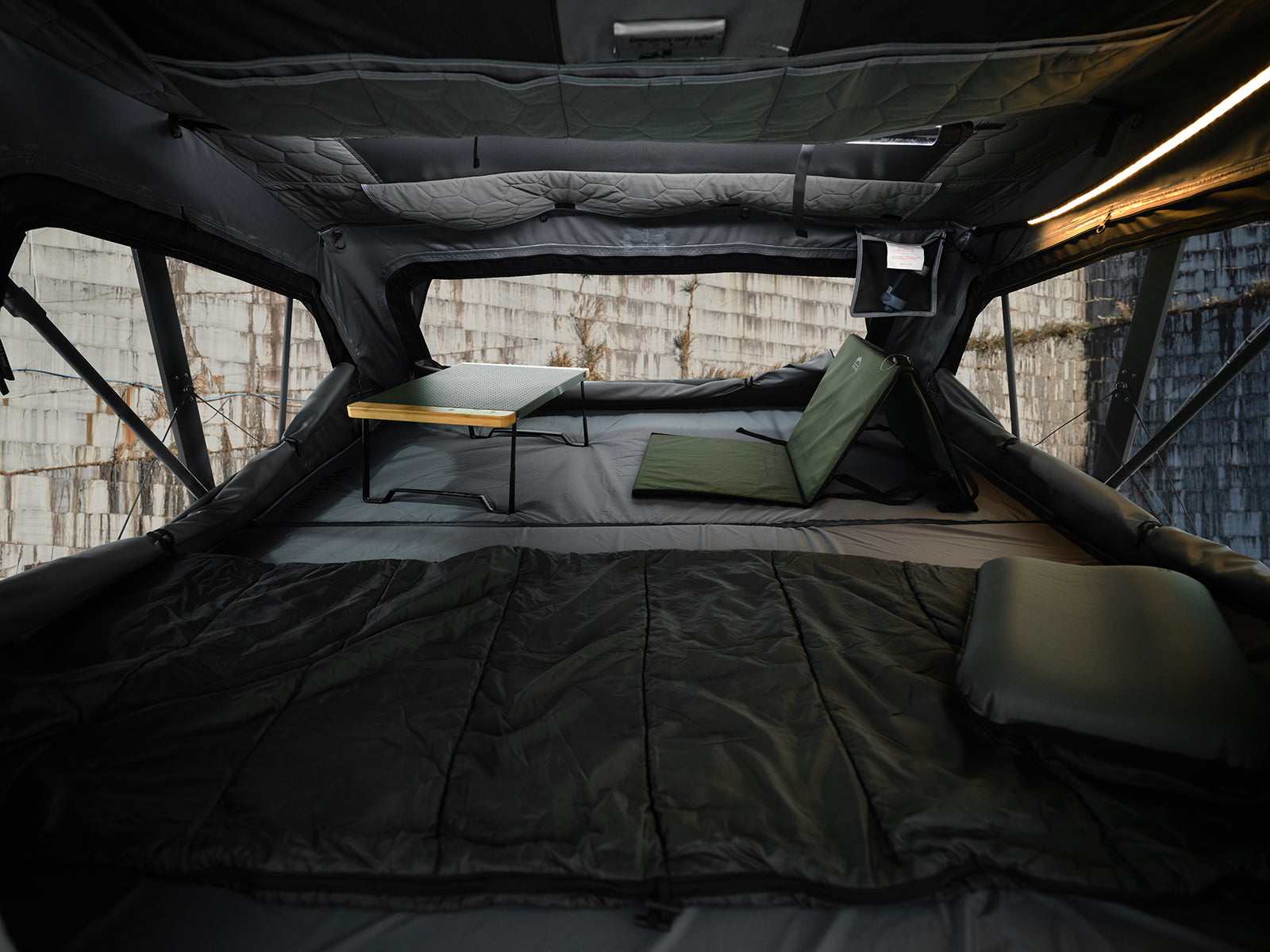
Softshell often has more space inside the tent when it's closed. That means you can in many cases leave more bedding, pillows and sometimes even an extra comfort mattress in the tent when you pack up.
Many hardshell tents also have room for duvets and sometimes pillows, but if you want to be able to leave a lot of extra sleeping gear or an extra mattress, softshell is often more forgiving.
Often lower weight – but not always
A common belief is that softshell always weighs less than hardshell. That's often true, but not always. It depends a lot on model, size and construction.
In our range, softshell tents weigh from around 36 kg up to about 77 kg. Hardshell tents start from around 50 kg and go up to about 78 kg. That means a smaller softshell is often lighter than a hardshell, but in larger sizes the difference can look different.
A good example is our larger models Wild Cruiser 250 and Voyager Pro 230, which are both large family tents. There the hardshell Voyager Pro actually weighs less than the softshell Wild Cruiser, even though both are built for families and larger sleeping areas.
Common misconceptions
“Softshell is always bigger”
This is a common myth. Softshell comes in large models, but so does hardshell. Today there are hardshell tents from compact 2-person models all the way up to large family tents for 4–5 people. So you shouldn't choose softshell just because you think it's the only option if you need a lot of space.
“Softshell has more accessories”
That isn't true either. There are plenty of accessories for both hardshell and softshell. You can add, for example, load bars, an annex, awnings, comfort mattresses and other practical accessories depending on the model.
“Hardshell is always heavier”
Hardshell can be heavier than softshell, but it's not a rule. The most important thing is to compare specific models, not just the category. Always look at the tent's actual weight, the car's roof load and how much equipment you want to be able to bring.
Comparison: hardshell vs softshell
| Priority | Usually the best choice | Why |
|---|---|---|
| Fast opening and closing | Hardshell | You usually avoid a separate travel cover and have fewer steps. |
| Low profile on the car | Hardshell | A thinner construction often means less wind noise and smoother driving. |
| Option to load on top | Hardshell | Many models can be fitted with load bars for solar panels, bikes or extra luggage. |
| Lower price | Softshell | You often get more sleeping space for a lower cost. |
| Room for extra bedding | Softshell | Softshell often has more interior space when the tent is closed. |
| Lowest possible weight | Depends on model | Smaller softshells are often lightest, but larger hardshells can weigh less than some large softshells. |
| Family tent | Both work | There are large models in both hardshell and softshell. |
Choose hardshell for maximum convenience
Hardshell is usually the right choice if you want a roof tent that is fast, simple and practical to use often. It's especially good if you want to be able to change location often, get going quickly in the morning and avoid extra steps such as separate travel covers.
Hardshell is also a good choice if you want to be able to load equipment on top of the tent, such as solar panels, bikes, extra luggage or other accessories. That means the car keeps more of its flexibility even when the roof tent is mounted.
Hardshell suits you best if you:
- Want fast and easy opening and closing
- Often change camp and travel on the next day
- Want a low profile and less wind noise while driving
- Want to be able to mount load bars on top of the tent
- Want to avoid storing a wet cover in the car
- Want a more easy-to-use roof tent day to day
Choose softshell for the most tent for your money
Softshell is a really good choice if you want plenty of sleeping space at a lower price. It's also a good option if you prioritise being able to leave more bedding, pillows or an extra mattress in the tent when it's closed.
For those who stay several nights in the same place, the slightly longer opening and closing often matters less. Then softshell can give a lot of comfort and space for the money.
Softshell suits you best if you:
- Want a lower price
- Want plenty of sleeping space for the money
- Want to be able to leave more bedding in the tent
- Want to be able to keep an extra mattress in the tent
- Prioritise low weight in the smaller models
- Often stay several nights in the same place
Our advice
For most customers who want to use the roof tent often, travel between different places and have as little hassle as possible, hardshell is the best choice. It's faster day to day, quieter on the car and gives you a better chance to use the roof for more than just the tent.
But softshell still has a clear place. If you want a cheaper roof tent, more room for bedding or an extra mattress, or if you mainly stay several nights in the same place, a softshell can be exactly right.
So the most important thing isn't just whether the tent is hardshell or softshell, but how you'll actually use it. Will you travel often and move camp almost every day? Choose hardshell. Do you want lots of sleeping space for a lower cost and prioritise extra storage space inside the tent? Choose softshell.
Why we work with Wild Land
We are the general agent for Wild Land, one of the world's largest manufacturers of roof tents with over 25 years of experience. That allows us to offer a wide range of both hardshell and softshell, from light 2-person tents to large family models for 4–5 people.
With us you'll find hardshell tents from around 50 kg up to about 78 kg and softshell tents from around 36 kg up to about 77 kg. That means there are models for many different cars, families and ways of travelling – whether you prioritise low weight, quick handling, a large sleeping area or maximum flexibility.
Summary
Hardshell is usually the most convenient choice if you want to travel easily, quickly and flexibly. Softshell is a strong choice if you want more roof tent for the money, more room for bedding and a lower entry price.
If you're unsure, the best question is usually: do you want the roof tent to be as simple as possible to use every day, or do you want to maximise space and value? The answer to that question usually makes the choice much easier.
Have questions? Contact us and we'll help you find the right tent.